Why do you need a front-end developer on your team?
Full-stack developers can build a working interface. A front-end developer owns how it behaves for the user: on every screen, on a slow connection, with a keyboard, as the product grows. In this article: when full-stack is enough, the signals that your team needs a dedicated front-end developer, what it changes for your product, and how to fill the role.
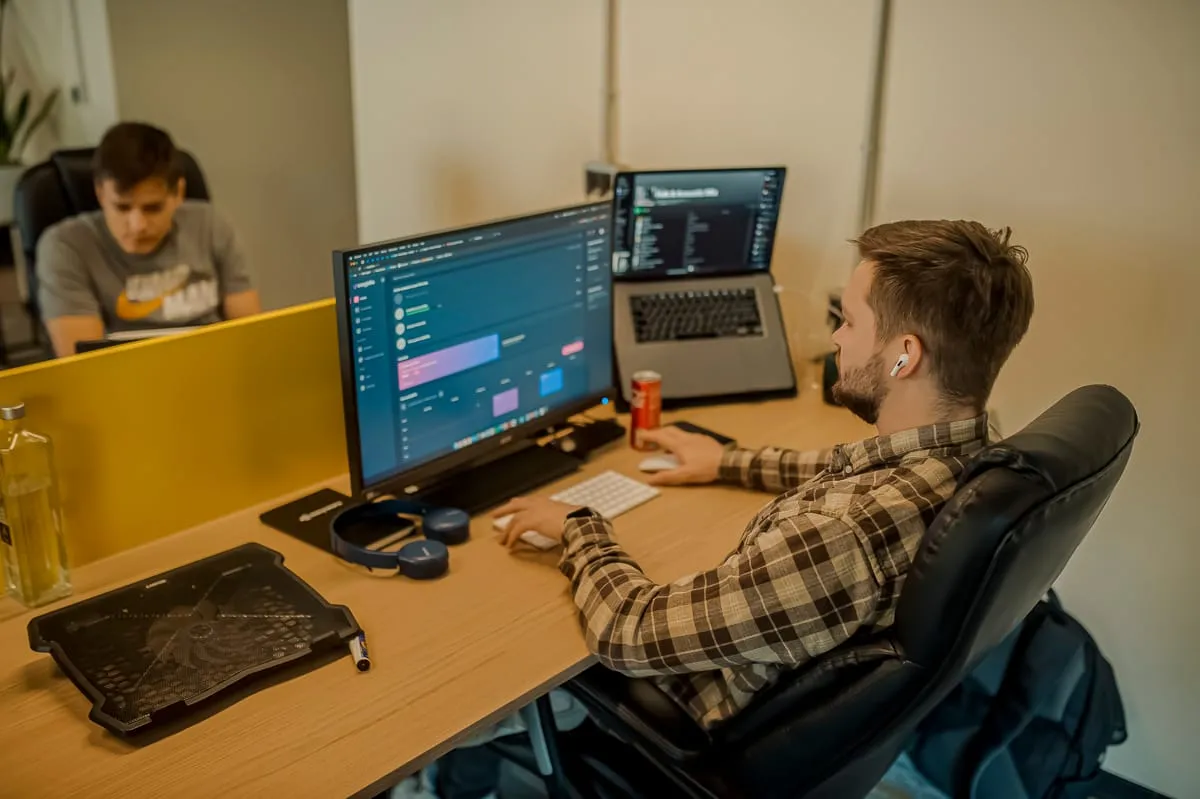
A front-end developer owns the part of your product your customers actually touch: the interface in the browser or the app, how fast it loads, how it behaves on every screen, and whether it keeps working as features pile up. A full-stack team can build screens too. The question for your team is when that stops being enough, and what a dedicated front-end developer changes once it does.
What does a front-end developer do in a product team?
A front-end developer turns designs and requirements into an interface that works for every user, on every device, and stays maintainable as the product grows. That covers the visible screens and the structure beneath them: components, state, data loading, performance and accessibility.
Day to day that comes down to:
- Building the interface in the framework your product uses, for example React, Vue or Angular.
- Setting up a component structure that the next feature can reuse instead of copy.
- Handling state and data from the API, including loading, empty and error states.
- Making the interface work on phones, tablets and desktops, and in the browsers your customers use.
- Keeping the product fast: load time, bundle size, and how quickly a screen responds to input.
- Making it usable with a keyboard and a screen reader, which is part of building it properly and not an extra.
When is a full-stack developer enough?
A full-stack team is enough as long as the interface is not where your product competes. Internal tools, admin panels and products with mostly forms and tables are often built well by developers who switch between server and browser. Full-stack can suffice there, as long as the team meets the usability, accessibility and performance requirements the product has.
It changes once the interface is what the customer judges. Many full-stack developers lean towards one side, and in practice that is often the back end. Front-end work then gets done, but nobody owns it: every developer solves the same interface problem in their own way, and the code in the browser grows faster than anyone tidies it.
When does your team need a dedicated front-end developer?
Add a front-end developer once the interface structurally slows the team down or shows up in complaints, churn or lost deals. The signals usually show in the backlog and in support before anyone names the role.
Concrete signals:
- Customers or sales mention that the product feels slow or dated compared to a competitor.
- Screens break on mobile or in a specific browser, and the fix comes from whoever has time.
- Every new feature needs its own buttons, forms and tables, because there is no reusable component set.
- Designs are handed over and come back looking different, and nobody at the table can say what a design costs to build.
- You are launching a customer portal, a web app or a redesign that has to work for users outside your company.
- Accessibility requirements are coming from customers or procurement, and nobody on the team knows where the product stands.
What does a front-end developer change for your product?
The first change is ownership. One person decides how the interface is structured, so the second and third feature reuse what the first one built. That can reduce rework over time, provided the team actually reuses those components, and it keeps design and code from drifting apart.
The second change is in what your customer experiences. Load time, behaviour on a phone and use without a mouse are things a user notices without being able to name them. A front-end developer measures them, fixes them, and keeps them from slipping back with the next release.
The third change is in the conversation with design. A front-end developer in refinement can say early which part of a design is cheap to build and which part costs a week, so the choice is made before building starts rather than halfway through the sprint.
How does a front-end developer work with the rest of the team?
The front-end developer agrees the API contract with the back end: which data a screen needs, in what shape, and what happens when it is missing or slow. What the back-end side of that decision looks like is covered in why you need a back-end developer on your team.
With QA the split is clear. The front-end developer tests their own work and writes component and interface tests; a QA engineer tests what happens when a user does something else, across devices and flows. How that role works is in why you need a QA engineer on your team.
The product owner prioritises which screen goes first, and the team agrees together on what a release has to meet. Where a project manager fits beside that is in why you need a project manager on your team.
How do you fill the front-end developer role: freelancer, agency, or extended team?
There are three routes: hiring a freelance front-end developer, having an agency build the interface, or adding a front-end developer to your team through a nearshore extended team. They differ on who directs the work day to day, how long the same person stays with your product, and where the knowledge of your interface sits afterwards.
A freelancer is the fastest route for a bounded piece of work: a redesign, a migration to a new framework, a peak before a launch. When the assignment ends, much of the knowledge of your component structure often leaves too, so what stays behind is what was documented and tested.
An agency takes the interface off your hands, usually with its own designers and its own way of working. That fits a separate product or a one-off project. It fits less well when the interface is part of a product your own team keeps developing, because an agency often works outside your sprint and your code review.
In a nearshore extended team the front-end developer joins your team and works only on your product, on your board and in your code review. Backstage IT handles recruitment, office, HR and operations in Moldova; you direct the work, the sprints and the priorities. It is neither a freelancer nor a secondment. We recruit on the profile you agree with us, we hold the interviews together, and you choose the developer. Our developers stay for years, so the knowledge of your interface stays with your product.
It takes 3 to 6 weeks from the first conversation to the day your new developer starts, depending on the requested profile. You can start with one front-end developer alongside your existing team and add more when the work calls for it.
Not sure whether your product needs its own front-end developer yet? Lay out your situation briefly and we will look at where your interface is holding the team back. Get in touch.