Software agency, in-house team, or nearshore extended team: which fits?
Need more development capacity but unsure about the shape? We put three models side by side (software agency, in-house, and nearshore extended team), with the honest best fit for each, so you make the right call the first time.
Short answer: you have roughly three ways to expand your development capacity. A software agency takes on a well defined project with a fixed scope and an end date. An in-house team you build yourself and locally, with your own hiring and people in the office. A nearshore extended team is a dedicated team in a nearby country, in our case Moldova, that you direct yourself and that becomes part of your organisation. Pick an agency for one-off delivery, in-house when co-location is truly required, and an extended team for ongoing development with direct control.
What options do you have to expand your development capacity?
You choose roughly between three models. Around them run two cross-cuts: doing it yourself or outsourcing, and offshore or nearshore. The defining differences are below.
Where the models differ:
- Software agency or project agency: you outsource a project, the agency delivers the result and sets its own way of working.
- In-house or local team: you hire yourself, you direct yourself, and everyone sits together physically.
- Nearshore extended team: you direct the work, but hiring, office, and HR sit with a partner in a nearby country.
- Contracting or freelance: you hire an individual temporarily for extra hands, usually without a fixed team or built-up product knowledge.
- Offshore or nearshore: offshore is far away with a large time difference, nearshore is close by with overlap in workday and culture.
Definition, short:
- Extended team: you steer day to day; a partner handles hiring, HR, and office in a nearby country (nearshoring).
- Software agency: you outsource scope and responsibility; the agency delivers once.
- In-house: you hire and build the team locally, on your own payroll.
At a glance:
| Criterion | Software agency | In-house team | Extended team |
|---|---|---|---|
| Control | The agency sets the way of working | You steer yourself | You steer yourself |
| Scope and duration | Bounded, one-off | Ongoing | Ongoing |
| Hiring, HR, and office | With the agency | Your own burden | With the partner |
| Product knowledge | Leaves after delivery | Stays in-house | Stays in the team |
| Staff turnover | Team changes per engagement | Higher in the tight Dutch market | Lower, people stay longer |
| Time to start | Varies, the agency schedules it | Slow, your own hiring | 3 to 6 weeks |
| Location | Remote | Local, together in the office | Nearby, full workday overlap |
| Best fit for | A one-off project | Co-location as a hard requirement | Ongoing development that you direct |
Below you will read, per model, when it is the best choice and when something else fits better.
When do you outsource a project to a software agency?
A software agency fits best for a project with a clear scope and an end date. Think of a new website, a standalone app, or a migration. You buy a result, not a team. The agency handles people, planning, and delivery. Once the work is done, the collaboration ends. For one-off work with no ongoing development need, that is efficient. Agree up front who handles maintenance and security updates after delivery.
Good fit:
- You have a project with a fixed scope and a clear end point.
- You have no ongoing development need after delivery.
- You want to hand off execution entirely.
- You have no time or desire to direct a team yourself.
Poor fit:
- Your product keeps growing and needs continuous development.
- You want to steer the details and sit close to the developers.
- Product knowledge must stay in your organisation, not leave after delivery.
- Your scope changes often, so you keep renegotiating.
When is building an in-house team the right step?
Building an in-house team fits when co-location is essential for you and you can handle the hiring. Everyone sits in the office, works at the same desk, and shares knowledge spontaneously. That works, but it takes time, budget, and hiring power. The talent pool in the Randstad is tight and overstretched. Dutch collective-labour wages rose 5.0% in 2025, so good developers are scarce and expensive. Hiring, onboarding, and retention all come on top.
Good fit:
- Sitting together physically in the office is a hard requirement for you.
- You have budget and time to hire and onboard yourself.
- You can compete for scarce talent in a tight market.
- You want developers fully on your own payroll.
Poor fit:
- You can barely fill your local vacancies.
- You do not want hiring, HR, and office overhead on top.
- You need extra capacity fast and cannot wait months.
- Your product owner already lacks time to manage a growing team.
When is a nearshore extended team (nearshoring) the answer?
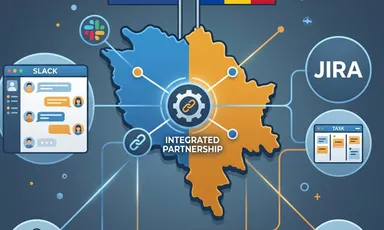
A nearshore extended team fits when you need ongoing development, want to direct it yourself, and want the team to integrate with your in-house team. You get a dedicated team in Moldova that runs one hour ahead of the Netherlands, so your workdays overlap almost fully. You set sprints, priorities, and what “done” means. We handle hiring, office, and HR. The team becomes part of your organisation, with no external agency in between.
Why this often fits a scale-up:
- Direct control: you direct the developers yourself, with no extra layer in between.
- Continuity: the same people stay longer, while in the tight Dutch market developers switch jobs faster. Product knowledge stays in the team, crucial for your roadmap.
- Time zone and travel: Moldova is one hour ahead and within 3 hours’ flight from Amsterdam, so an on-site visit is easy to plan.
- Communication in English: in Chișinău, where the IT sector sits, English is strong (EF EPI 2025 “High”; national “Moderate”).
- Quick start: it takes 3 to 6 weeks from the first conversation to the day your developer starts, depending on the requested profile.
- Room to scale: you start small and grow the team when your product calls for it.
Backstage IT builds these teams from the Netherlands, with 17+ years of experience building international development teams. Want to see how such a team integrates with your in-house team in practice? Read how nearshore works for Dutch companies and why we chose Moldova.
When an extended team does not fit: if you only have one-off work with a fixed scope, an agency makes more sense. If sitting together physically is a hard requirement, choose in-house. And for short jobs of a few weeks an extended team is too heavy; contracting or a freelancer is enough. An extended team pays off only when the collaboration continues. Read more about how it differs from other collaboration models in extended teams vs outstaffing and the benefits of an extended team.
How do you choose? Three questions that settle it
The choice becomes simple once you answer three questions honestly. They cover the nature of the work, who steers, and whether everyone has to sit together physically.
- One-off or ongoing? A project with an end date points to an agency. A product that keeps growing points to a team.
- Steer yourself or outsource? If you want to steer the details, choose in-house or an extended team. If you want to hand it off, choose an agency.
- Everyone local or is overlap enough? If everyone must sit in one office, choose in-house. If a full workday overlap is enough, nearshore works.
In short: an agency for one-off delivery, in-house when co-location is required, and an extended team for ongoing development that you direct yourself.
Torn between two models?
If you are torn between two models, settle it on control. If you want to set sprints and priorities yourself, an agency drops out. If co-location stays a hard requirement, nearshore drops out. If doubt remains after that, start small and scale up once the model proves itself.
Lay out your situation briefly and we will think along, even if an extended team turns out not to be the best fit. Get in touch and we will look together at which model fits.